// AI Product
Sharpenn
AI Product Consultant · Sharpenn Technologies Pvt Ltd · Sep 2024 – Present
A self-governing AI marketing system for a filtration manufacturer: one governing brain, two execution arms, built solo from strategy to a live outbound campaign.
3
Agents shipped
29/29
Steps verified
93%
Deliverability
0
Name leaks
// Problem
Sharpenn is a specialist manufacturer of electrolyte filtration equipment for non-ferrous refining. It had decades of product credibility but no scalable, consistent go-to-market engine. Market research, outbound, and content each required senior judgment, strict confidentiality, and one consistent strategy across every channel. The website had near zero traffic, so even strong demand had nowhere to land. Manual execution does not scale, and disconnected tools break strategy and guardrails.
// My call
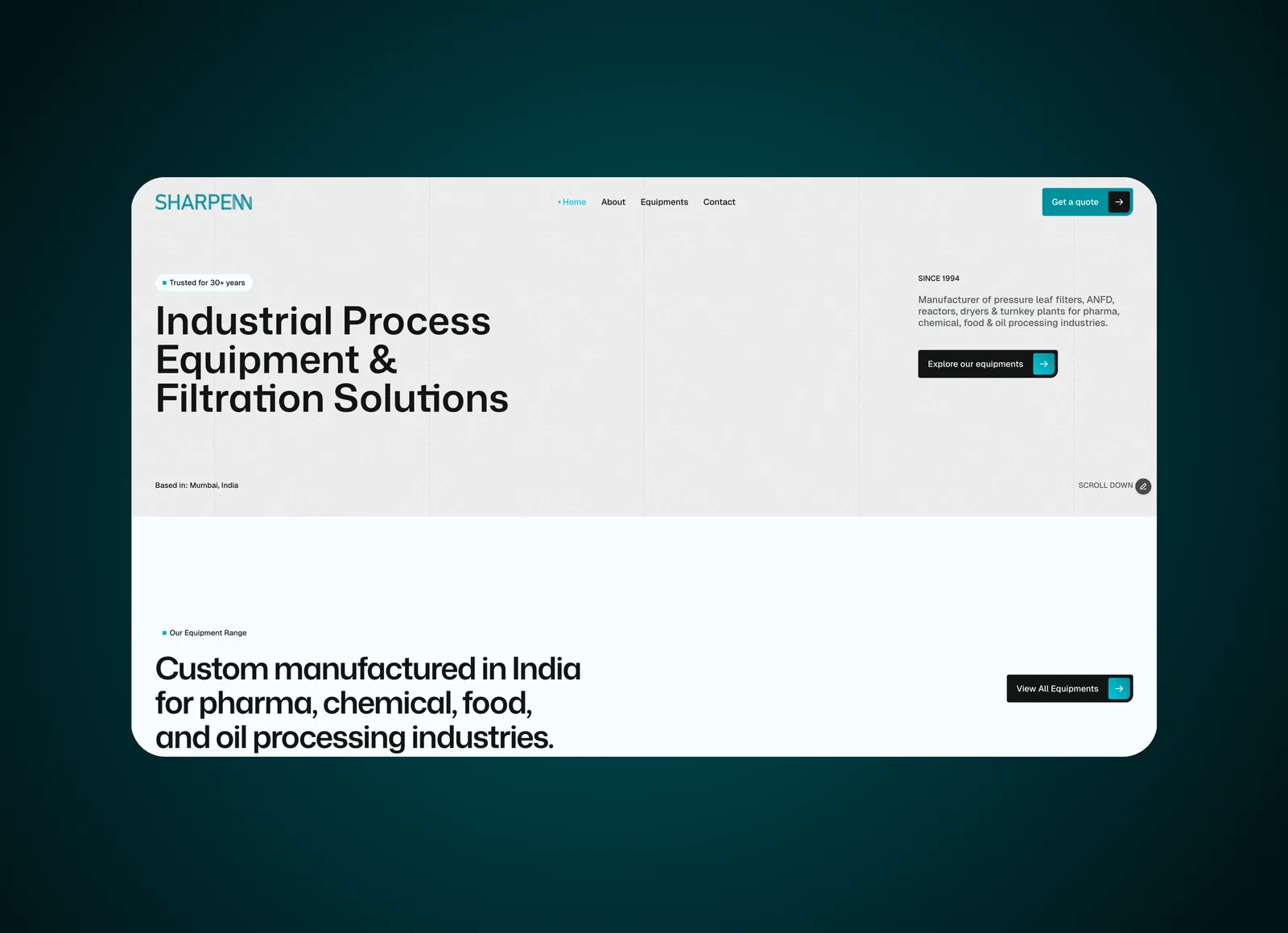
I chose to build one governing brain with two execution arms instead of separate disconnected bots. AIMM, the brain, owns strategy, messaging, guardrails, the company database, the content plan, reply drafting, and a review gate. On any conflict, the brain wins. AISDR runs verified outbound email, and AICC writes answer first, get cited blog content in an engineer to engineer voice. Two product decisions mattered most: confidentiality is enforced system wide so client names stay internal grounding only and never leak, and human gated sends with human approved replies ensure the AI drafts and sequences but a person always approves before anything leaves. I relaunched the website as an answer first, schema rich property so the brand had a citable home before outbound and content scaled.
click to expand
// What I shipped
I shipped the full system solo, from strategy to live infrastructure. That included the AIMM brain with a verified company database, country market strategy, an answer engine and search content plan, and a live command center dashboard reading the database in real time. I built the AISDR outbound foundation with a dedicated sending domain fully authenticated through SPF, DKIM, and DMARC, plus an inbox connected to a sequencing tool, warmed and then ramped into live sending. I built the AICC content engine with ranking blog posts live and dynamic Article and FAQPage schema emitting on every post automatically. The relaunched website took GA4 traffic from zero to 171 active users. Before any of it sent, I ran a pre send verification pass on every target in the first wave and caught a live tone failure: the drafted opener would have congratulated a site on new investment while its parent was preparing it for care and maintenance amid failed pay talks. I re angled that thread from capital equipment to consumables and reassigned the persona. I also audited the client's live website against the same guardrails and closed a naming breach, correcting two banned product terms across five pages and confirming a clean scan afterward.
// Outcome
The result is a working, governed marketing system where strategy, guardrails, and learnings stay consistent across every channel. I verified it end to end: zero client name leaks across all outputs, full email authentication confirmed on the authoritative nameservers, and citable content live with schema verified in the page HTML. The first cold outbound campaign went live at the end of July 2026 across 6 buyer personas, sending to a verified prospect list on per recipient timezone schedules. Sender health is measured, not assumed: an independent warm-up tool reports a setup score of 100, protected reputation, and 93% deliverability. That number covers the sender and its peer network, not enterprise gateways like Mimecast or Proofpoint, so I treat it as a clean read on sender identity and an open question on enterprise placement. All 29 sequence step bodies were verified 29 of 29 through the REST API rather than the tool's own interface, because a success response is not proof the stored copy is what you intended. Two failures are worth more than the metrics. I shipped the campaign in plain text on a deliverability argument, tested a live email on a phone, and found it double wrapping into something that looked broken. The root cause was hard wrapping at 72 characters with no format=flowed, so I reversed my own decision, rewrote all 29 bodies as HTML, and re-verified every one. Later a recipient pressed block sender and the gateway rejected touch 2. I suppressed the address and its domain, then wrote the case up as a standing deliverability rule so the next campaign inherits the lesson rather than repeating it. On the content side, posts are live against seven pillars. The website went from 0 active users in the pre build window to 171 active users across 7 countries, with organic search at 54% of sessions and AI assistants already a live referral source before the blog program had ramped. Reply and meeting metrics are not in yet, and I would rather show them when they are real: this is a live case study, updated as the campaign reports.
// How I built ittechnical
I used hierarchical multi agent orchestration, with AIMM led, AIMM on Opus, AISDR on Sonnet, and AICC on gpt-5.4-mini. The outbound stack runs from a grounding sheet to contact find and enrich, email verification, Claude to write and classify, a human gate, then a sequencing tool for schedule, warmup, and replies, with feedback written back to the sheet. Scheduling is per recipient timezone and business hours only. Content is answer first plus JSON-LD for citability, with a Framer code component bound to CMS fields that emits Article schema on every post and FAQPage when the FAQ field is set. A shared state sync back rule keeps the brain in sync when an arm is worked with directly, and the skills are backed up to a private GitHub repo. One decision is worth recording because it reversed. I first sent in plain text for deliverability, then a real device check showed the format hard wraps and double wrapped on a phone, so I moved every one of the 29 email bodies to HTML and verified all 29 through a separate REST read path rather than trusting the write API's success response. That habit was earned: a component API on the website had already reported success while silently changing nothing.
AI/LLMSaaS0-to-1Agentic AIGTM